Maersk Line, Hamburg Süd, Safmarine: A 2019 Golden Gate Photo of Brands Maersk Has Since Retired
The photo was taken in October 2019 from the Marin side of the Golden Gate. A mid-size Maersk boxship is moving through the strait, Baker Beach and the houses of Sea Cliff and the Outer Richmond stacked up behind it. Oakland is a short run ahead. Nothing about the scene is unusual. Ships like this pass under the bridge every day.
What makes it worth a second look is the paint. The hull still reads MAERSK LINE in big white letters. That name is gone. So are most of the other brands riding on deck.
Count the boxes. Pale blue Maersk units dominate, but there are red Hamburg Süd containers in almost every bay, a scattering of Safmarine boxes, some Sealand, and a few Hyundai units mixed into the stacks. In one frame you get five brands. Seven years later, Maersk sells under one.
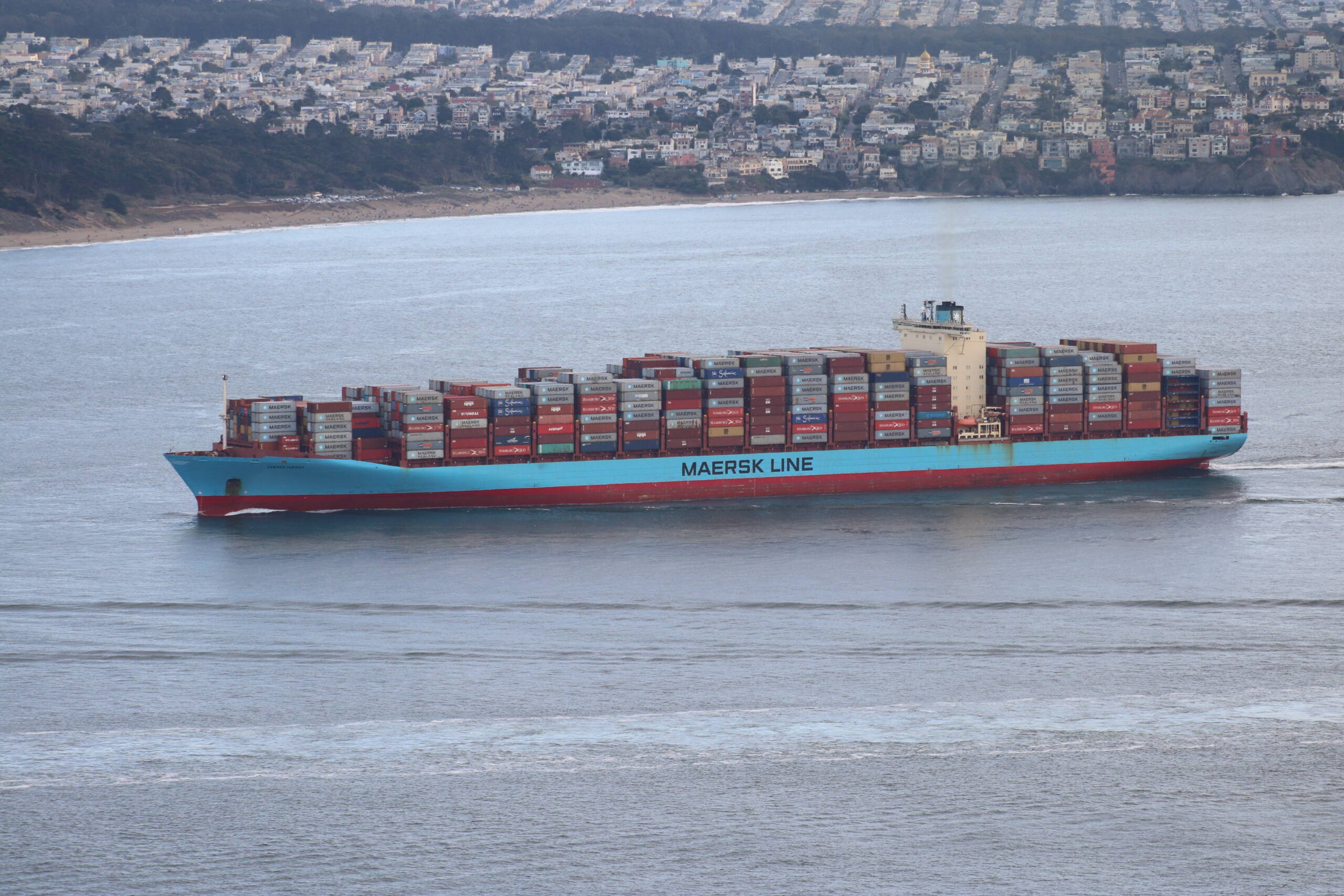
Photo: pxef.com
The hull is a fossil
Maersk Line was the shipping arm of A.P. Moller-Maersk for decades, and for most people in the trade the two names meant the same thing. Then the group decided it wanted to be an integrator. Ocean, terminals, trucking, warehousing, customs, all sold under one roof and one logo. A separate "Line" brand made no sense in that pitch, so the company folded it into plain Maersk. Repainting a fleet takes years, which is why hulls like this one kept the old name long after the brochures dropped it.
Safmarine went first among the acquired names. Maersk announced in 2020 that the South African-rooted brand and its forwarder Damco would be shut down by the end of that year. Hamburg Süd lasted longer. Founded in 1871 and bought by Maersk in 2017, it kept its own sales force and its strong Latin America network for several years. In January 2023 Maersk said it would retire both Hamburg Süd and Sealand in favor of a single brand. Sealand carries a heavier history than most. It traces back to Malcom McLean, whose converted tanker Ideal-X ran the first container voyage in 1956.
So the deck of this ship is a small museum of the consolidation. Every red Hamburg Süd box is a German company that existed for nearly 150 years and now survives mostly as paint nobody has redone yet.
The Hyundai boxes tell the alliance story
The HMM containers are the other clue. In 2019 Hyundai Merchant Marine was a strategic partner of 2M, the Maersk and MSC alliance, which is why its boxes turned up on Maersk tonnage on transpacific loops like this one. That arrangement ended in 2020 when HMM moved to THE Alliance.
2M didn't survive either. Maersk and MSC let it expire in early 2025. MSC chose to run alone. Maersk teamed up with Hapag-Lloyd in the Gemini Cooperation, which started on 1 February 2025 with a hub-and-spoke network of mainline and shuttle services, about 340 ships and 3.7 million TEU deployed.
The pitch for Gemini was reliability. Fewer port calls on the big loops, feeders doing the rest, and ships that arrive when the schedule says. Gemini says its services ran around 90% on time in the first year. The industry as a whole was still in the low 60s this spring.
One brand, two very different years
Reliability doesn't set freight rates. Maersk opened 2026 with guidance that allowed for an operating loss, an EBIT range from minus $1.5 billion to plus $1 billion, as the Suez return and new ship deliveries pointed to overcapacity. Then the Gulf war and strong Far East demand pushed spot rates up. Maersk raised its underlying EBIT forecast to $2 billion to $4 billion, and its Q2 EBIT almost doubled to $1.6 billion.
As of Oct 10 2026 the next test is the third-quarter report, due on 5 November. The ships ordered in the boom years are still arriving. When the Gulf premium fades, the overcapacity that worried the industry in January will still be there.
That's the uncomfortable part of the integrator bet. One brand, one network and one customer interface are cleaner. They don't stop a freight market from turning. The ship in this frame sailed in a world of many brands and a big alliance with MSC. Today it would carry a single logo, sail inside a smaller partnership, and live off a rate spike that started with a war.
Same ship, probably. Same bridge. Very different company.