Hormuz at 75 and Taiwan Strait at 33.4 Put Shipping on Two Different Risk Tracks
Shipping faces two distinct kinds of chokepoint exposure as November begins. In its November 1 report, Hormuz.net puts its first Hormuz Risk Gauge at 75, in the High band, with attacks and tanker equities driving the reading. TaiwanStrait.com launches its Taiwan Strait Tension Index at 33.4, or Watchful, despite a sudden increase in PLA aircraft activity. For carriers, charterers and cargo owners, the distinction matters: the Gulf report describes disruption already affecting access to cargo, while the Taiwan report describes pressure that warrants contingency planning.
Both publications average four equally weighted inputs on scales from zero to 100, but their ingredients and observation periods differ. Hormuz combines oil prices, tanker share prices and maritime incidents; Taiwan combines military activity, semiconductor equity performance and escalation headlines. A reading of 75 is no claim of a 75% closure probability, and 33.4 cannot be treated as a directly comparable measure of voyage safety. The infographic places the source readings side by side while preserving that warning. Its orange Hormuz panel pairs the score with attacks, transits and market stress; the blue Taiwan panel pairs its lower reading with aircraft activity, persistent ship presence and relative equity performance.
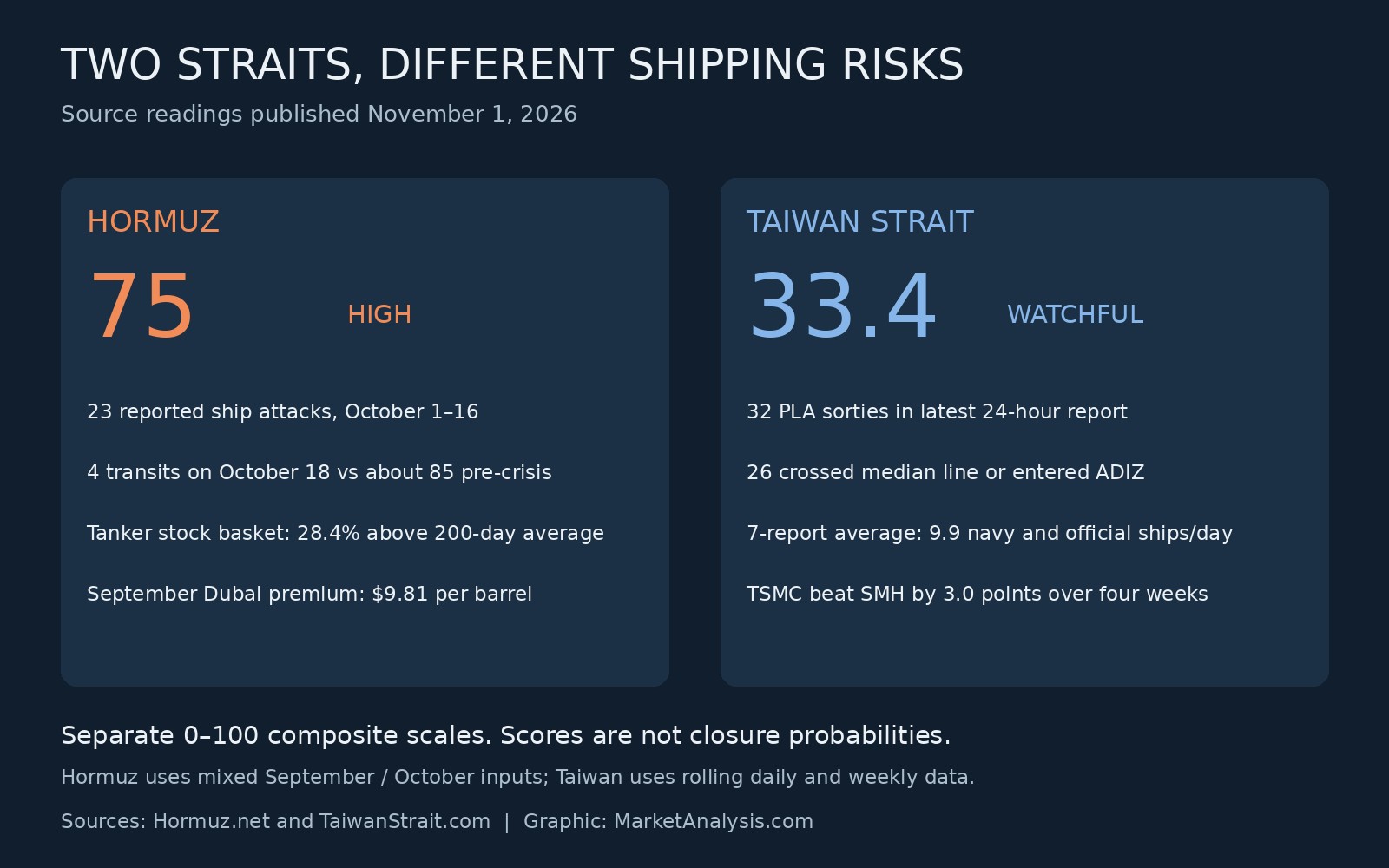
Graphic: MarketAnalysis.com. Findings credited to Hormuz.net and TaiwanStrait.com.
Hormuz.net reports 23 attacks on ships in or near the strait during October's first sixteen days, including 12 in the week to October 11. It cites IMF PortWatch recording four transits on October 18 against roughly 85 a day before the crisis. Those dates matter: four is the report's cited daily observation, not a verified November 1 traffic count. Even with that limitation, the scale of the reported collapse explains why assurances about escorted movements offer cargo owners little comfort. An available loading terminal does not solve the problem if the vessel cannot reliably reach it and leave.
The financial inputs reinforce the report's disruption thesis. Its five-owner tanker basket stood an average 28.4% above its 200-day moving average as of October 23, producing an input score of 85.6. Gulf incidents scored 100. Dubai crude's September average premium over Brent was $9.81 a barrel, while the Brent volatility calculation covered July through September. Hormuz.net expects newer monthly oil figures to raise stress readings, but that remains its forecast. The composite mixes dates and can lag operational changes.
For shipping businesses, higher tanker equity prices are an indirect signal. They can reflect expectations of scarce tonnage and longer voyages, alongside company-specific factors; they do not establish that a particular Gulf fixture is profitable or insurable. Charterers bear higher transport costs when suitable ships become scarce, owners face insurance and operating expenses, and crews face physical exposure. Buyers outside the region can seek replacement supply, but sailing around Africa cannot extract a cargo trapped behind Hormuz. The loading geography is the constraint.
TaiwanStrait.com describes a less acute picture with a persistent maritime component. It reports 32 PLA aircraft sorties in the 24 hours ending at 6 a.m. on November 1, with 26 crossing the median line or entering the air defense identification zone. The same daily report counted seven navy ships and two official ships. Across seven reports, combined naval and official presence averaged 9.9 ships a day. Aircraft activity surged after a quiet stretch; vessels remained present even on days with no detected aircraft.
The market input offers another distinction. Over four weeks to October 30, TSMC's US shares fell 14.1%, while the SMH semiconductor fund lost 17.1%. Relative outperformance kept that component below its neutral midpoint. This supports the source's interpretation that the selloff was not showing a distinct Taiwan penalty through that measure. It says little directly about marine insurance or container bookings, however, and the report does not establish a commercial shipping closure.
The operational lesson is to separate present disruption from escalation triggers. Gulf voyages need current transit evidence, voyage-specific insurance terms and credible loading arrangements. Taiwan exposure calls for monitoring sustained vessel concentrations, restricted areas, port access and carrier advisories, with a named exercise or repeated air surges prompting closer review. These are shipping implications drawn from the two reports. Cargo owners pay when uncertainty becomes inventory, delay or an alternative supply contract; watching how access changes is more useful than treating either headline score as a routing instruction.